How Each Connection Type Typically Handles Data
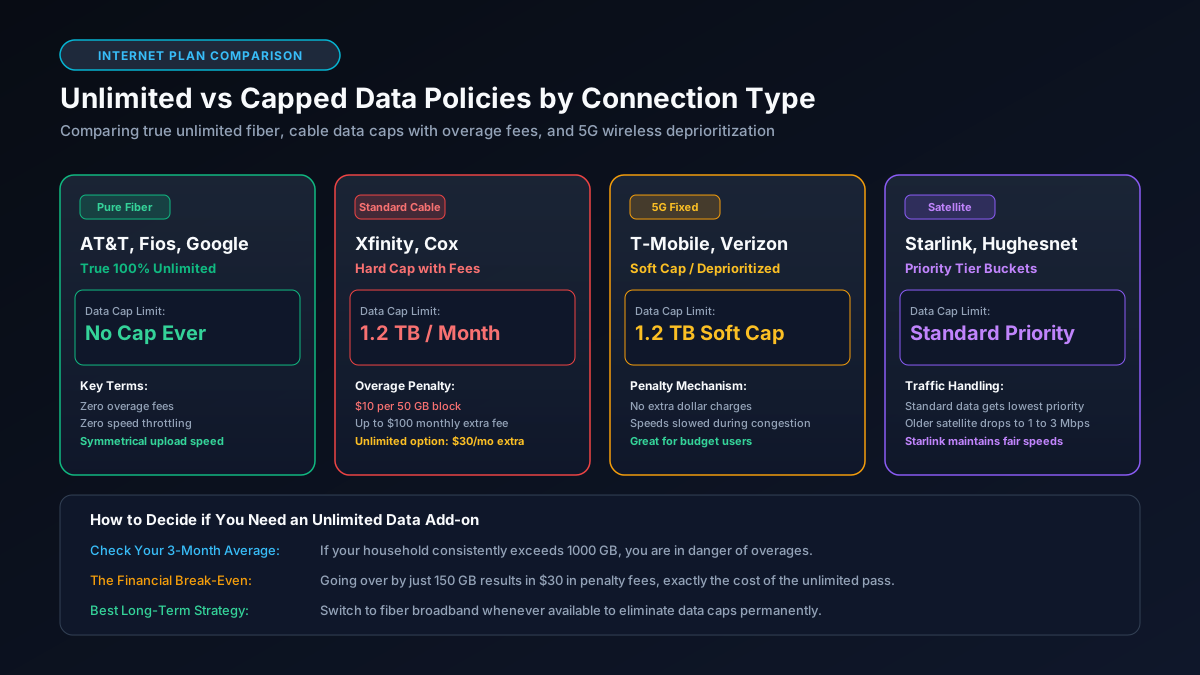
| Connection Type | Typical Data Policy | Examples |
|---|---|---|
| Fiber | Usually unlimited, no caps | AT&T Fiber, Verizon Fios, Google Fiber, Quantum Fiber |
| Cable | Mixed: some unlimited, some capped around 1 to 1.3TB | Spectrum (unlimited), Xfinity (often capped, unlimited available as an add-on), Cox (capped) |
| Fixed wireless / 5G home internet | Usually a soft cap with speed reduction, not overage fees | T-Mobile 5G Home Internet, Verizon 5G Home |
| Satellite | Priority data allowance, then reduced speed | Starlink, Hughesnet, Viasat |
| Cellular hotspot | Often the most restrictive, hard caps common | Varies significantly by carrier and specific plan |
Three Types of "Limits" You'll Actually Encounter
The word "cap" gets used loosely, but the real world impact varies a lot depending on which of these three a plan actually uses:
- Hard cutoff. Service stops or requires a manual upgrade once you hit the limit. This is rare on modern home internet plans but was more common historically.
- Overage fee. You keep your speed, but the provider charges extra, often a set amount per additional block of data, once you exceed the included allowance. This is how many capped cable plans currently work.
- Speed throttle (soft cap). Your speed is reduced, sometimes significantly, once you pass a certain amount of data, but there is no additional charge and service does not stop. This is the most common approach on fixed wireless, satellite, and many cellular plans.
Understanding which of these three applies to a specific plan matters more than just knowing whether it is labeled "capped" or "unlimited," since a "soft cap" and a genuinely unlimited plan can feel very similar in practice for a moderate user, while a hard overage fee can be a real cost for a heavy user.
Fiber: The Most Consistently Unlimited Option
Fiber internet providers have largely built their business around unlimited data as a standard feature rather than a paid add-on. AT&T Fiber and Verizon Fios both generally offer unlimited data across their fiber plans with no data caps. This is one of the clearer advantages of fiber over cable in markets where both are available, alongside typically faster and more symmetrical upload speeds.
Cable: Depends Heavily on the Provider
Cable internet is where the real variation shows up. Spectrum offers unlimited data on its standard residential plans with no hard cap. Xfinity, on the other hand, has historically enforced a 1.2TB monthly data cap on many of its plans, with unlimited data available as a paid add-on, though Xfinity has been shifting some newer plans toward unlimited by default and certain regions have longstanding cap exemptions. Cox similarly enforces a data cap, commonly cited around 1.25TB, with overage charges for exceeding it. Because this varies so much by provider and even by specific plan or region, checking your exact plan's terms directly is the only reliable way to know where you stand.
Fixed Wireless and 5G Home Internet: Soft Caps Are the Norm
T-Mobile 5G Home Internet and Verizon 5G Home Internet are generally marketed as unlimited, but "unlimited" here typically means no hard cutoff and no overage fee, paired with the possibility of speed deprioritization during network congestion once you are a very heavy user relative to other customers on the same local tower. For most typical households, this rarely becomes noticeable, but it is a meaningfully different guarantee than a fiber plan's unlimited data.
Satellite: Priority Data, Then Reduced Speed
Starlink, Hughesnet, and Viasat generally do not use hard data caps anymore, but they do use a "priority data" model: you get a set amount of higher-priority, faster data each month, and once that is used, speeds may slow noticeably during busy network periods, particularly on Hughesnet and Viasat's lower tiers.
How Much Data Actually Triggers These Limits?
Most households use far less than even a capped cable plan's 1 to 1.3TB allowance. See our complete guide to how much data you need per month for typical usage by household size, and our family of 4 data usage breakdown if you want to see where a busier household actually lands relative to these thresholds. For most light to moderate households, even a capped cable plan rarely becomes a real constraint, while heavy households with multiple 4K streamers, gamers, and remote workers are the ones most likely to want to confirm their plan's specific terms.
What to Actually Ask Your Provider
Since marketing language around "unlimited" varies, a few direct questions cut through most of the ambiguity:
- Is there a hard data cap, and if so, what happens when I exceed it: an overage fee, a speed reduction, or a service pause?
- Does my current plan include unlimited data standard, or is it a paid add-on?
- Is there any form of deprioritization or slowdown during network congestion, even on an "unlimited" plan?
Frequently Asked Questions
Is fiber internet always unlimited?
Almost always, yes. Major fiber providers like AT&T Fiber and Verizon Fios generally offer unlimited data as a standard feature rather than a paid extra, though it is still worth confirming for your specific plan and location.
Does Xfinity have a data cap?
Many Xfinity plans have historically included a 1.2TB monthly data cap, with unlimited data available as a paid add-on, though this varies by plan and region, and some newer plans and regions are exempt. Check your specific account for current terms.
What happens if I go over a soft data cap on 5G home internet or satellite?
Typically your speed is reduced, sometimes significantly during busy network periods, but you are not charged an overage fee and your service does not stop.
Which type of internet has the strictest data limits?
Cellular hotspot plans are generally the most restrictive, often with firm caps well below what home internet plans typically allow.
How much data does an average household actually use?
Most households use 300 to 800GB per month, well under most cable data caps and far under fiber's unlimited allowances. Heavy households with multiple 4K streamers and gamers are the ones most likely to approach or exceed a 1 to 1.3TB cable cap.