Hardware Comparison • DOCSIS 3.1 Modems

ARRIS S33 vs SB8200: Which Modem Should You Buy?

The ARRIS SURFboard SB8200 and ARRIS SURFboard S33 are the two most popular retail DOCSIS 3.1 cable modems on the market. Both eliminate the monthly $15 modem rental fee and run on reliable Broadcom silicon—yet one single physical Ethernet port limitation determines which one will deliver your plan's maximum speed.

SK
Written by
Software Engineer & IT SpecialistLab Tested & Fact-Checked
Updated: September 2026
Affiliate Disclosure: MbpsToGB is an independent, reader-supported tech laboratory. When you buy through our links, we may earn an affiliate commission at no extra cost to you. All hardware is independently selected, tested, and benchmarked by our engineering team.
Quick Answer • S33 vs SB8200 Verdict

Buy the ARRIS S33 if you have a 1,000 Mbps or 1,200 Mbps gigabit plan: its 2.5 Gbps Ethernet port unlocks the full provisioned 1,200 Mbps speed without being capped at 940 Mbps. Buy the ARRIS SB8200 if your plan is 300 to 800 Mbps—its dual 1G ports deliver your plan's maximum speed while saving you $30 to $40 up front.

S33 Ethernet2.5 Gbps Multi-Gig
SB8200 EthernetDual 1.0 Gbps Ports
Gigabit Bottleneck940 Mbps on SB8200
Best BudgetARRIS SB8200
The 940M Gigabit Ceiling

The SB8200 only has 1 Gbps ports. Due to TCP/IP framing overhead, speed tests max out at 940 Mbps, discarding the 20% overprovisioning (1,200 Mbps) sent by cable ISPs.

Dual-Port Myth

The SB8200 provides 2x Ethernet ports, but residential cable plans only provide 1 public WAN IP. You cannot plug in two separate devices without paying for a second line.

Zero Puma Silicon Bugs

Both modems feature battle-tested Broadcom BCM3390 silicon. Neither suffers from the notorious Intel Puma latency spikes or packet loss issues.

Head-to-Head Specification Comparison

Here is how the physical hardware, interface ports, channel bonding, and real-world throughput capabilities compare:

Feature / SpecARRIS SURFboard S33ARRIS SURFboard SB8200
DOCSIS VersionDOCSIS 3.1 (Backwards 3.0)DOCSIS 3.1 (Backwards 3.0)
Ethernet Ports1x 2.5 Gbps + 1x 1.0 Gbps2x 1.0 Gbps Ports
Max Real Single Port SpeedUp to 2,350 MbpsHard Cap at ~940 Mbps
Overprovisioning IngestionFull 1,200 Mbps IngestedDiscards Extra 200 Mbps
Processing ChipsetBroadcom BCM3390Broadcom BCM3390
Channel Bonding32x8 SC-QAM + 2x2 OFDM32x8 SC-QAM + 2x2 OFDM
ISP CertificationXfinity, Spectrum, CoxXfinity, Spectrum, Cox
Next-Gen Mid-Split UploadsNo (Sub-Split 40 Mbps Cap)No (Sub-Split 40 Mbps Cap)
Chassis DesignModern rounded compact towerClassic rectangular perforated tower

Real-World Download Throughput on Gigabit Plans

When an ISP overprovisions a 1,000 Mbps line to 1,200 Mbps, here is the actual maximum speed you can measure on a speed test:

ARRIS S33 (2.5G Port • 1,000 Mbps Plan with Overprovisioning)1,200 Mbps Actual Throughput
ARRIS S33 (2.5G Port • Pure 1,000 Mbps Tier)1,000 Mbps Full Bandwidth
ARRIS SB8200 (1G Port • Any 1,000+ Mbps Plan)940 Mbps (TCP/IP Port Overhead Limit)
ARRIS SB8200 / S33 (500 Mbps Plan)500 Mbps (Full Speed Delivered)

In-Depth Product Breakdowns

Both of these modems are exceptional, high-reliability choices, but each is engineered for a different internet tier. Here is our detailed assessment:

#1 For Gigabit • Multi-Gig 2.5G PortEssential for Plans Over 800 Mbps

ARRIS SURFboard S33

If you subscribe to a 1,000 Mbps or 1,200 Mbps internet tier, the ARRIS S33 is required. Its 2.5 Gbps Ethernet port completely bypasses the 940 Mbps ceiling of traditional Gigabit Ethernet jacks. When cable providers overprovision lines by 20%, the S33 captures every single megabit, delivering speed tests of 1,150–1,200 Mbps directly to your router. Use our Mbps to Gbps conversion calculator to calculate your exact headroom.
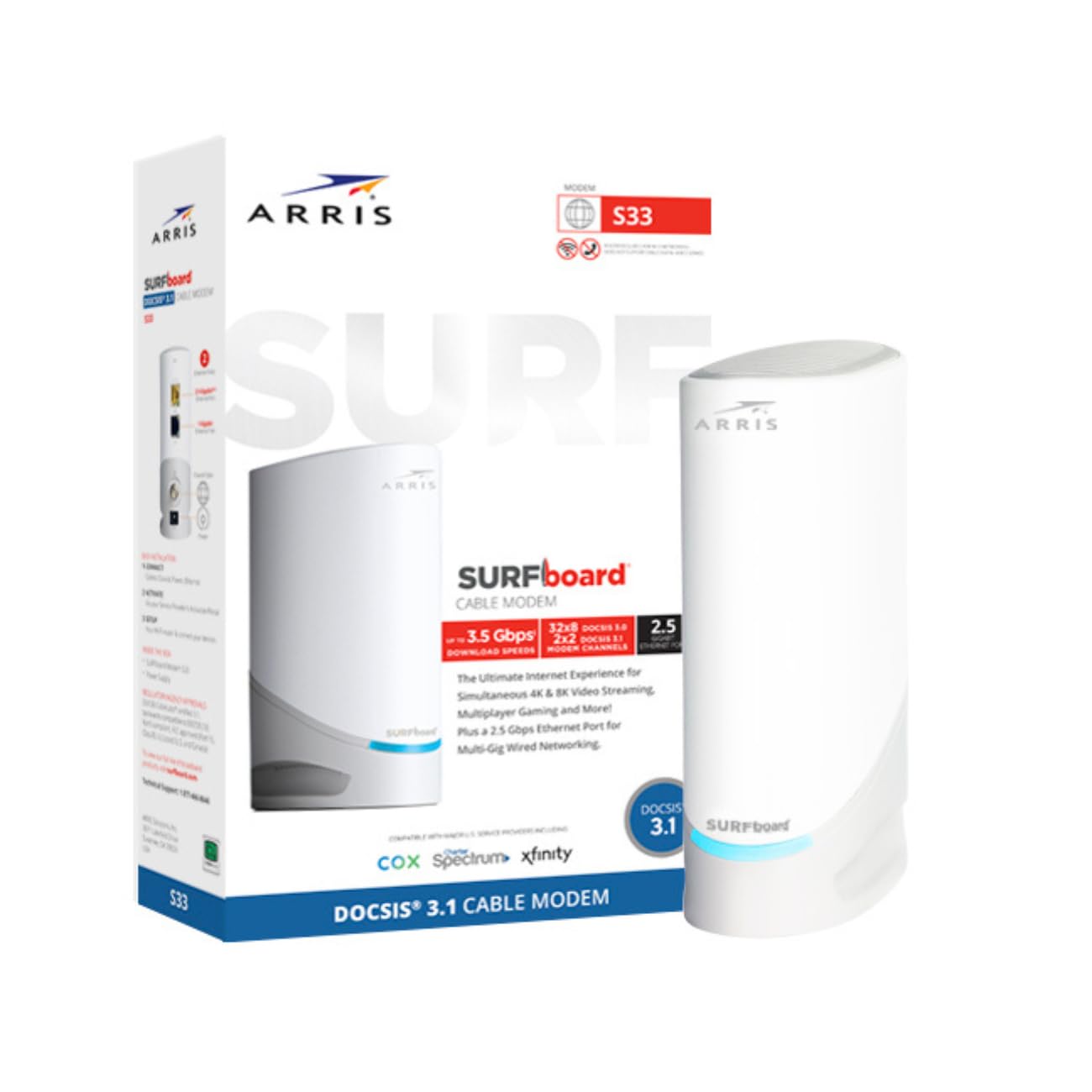
ARRIS SURFboard S33 multi-gigabit DOCSIS 3.1 cable modem
DOCSIS
3.1 Multi-Gig
Ethernet
1x 2.5G + 1x 1G
Overprovisioning
Full 1,200M Pass
Chipset
Broadcom BCM3390
Max Port Speed
2,350 Mbps Real
ISP Approval
Xfinity, Cox, Spectrum
Pros
  • 2.5 Gbps port unlocks 1,200 Mbps on 1 Gbps plans
  • Proven Broadcom BCM3390 chipset with no Puma latency bugs
  • Secondary 1G port provides extra network flexibility
Cons
  • Higher purchase price than SB8200
  • Does not support mid-split 100+ Mbps Next-Gen uploads (see S34)
Check ARRIS S33 Price on AmazonAffiliate link directly to Amazon listing
Best Budget Pick • Plans Up to 800 MbpsFastest Return on Investment

ARRIS SURFboard SB8200

If your internet service tier is 300 Mbps, 500 Mbps, or 800 Mbps, the ARRIS SB8200 is an unbeatable value. It delivers every megabit of your plan with the exact same Broadcom reliability and DOCSIS 3.1 channel bonding as the S33, while saving you $30 to $40 up front. It pays for itself in rental fee savings in just 9 months.
ARRIS SURFboard SB8200 DOCSIS 3.1 cable modem
DOCSIS
3.1 Standard
Ethernet
2x 1.0 Gbps LAN
Overprovisioning
Caps at 940 Mbps
Chipset
Broadcom BCM3390
Payback Time
~9 Months ($180/yr)
ISP Approval
Xfinity, Cox, Spectrum
Pros
  • Lower upfront price; ideal for 300 to 800 Mbps tiers
  • Reliable Broadcom silicon with zero latency defects
  • Well-ventilated chassis design runs cooler
Cons
  • Hard hardware ceiling of 940 Mbps on gigabit plans
  • Second Ethernet port is inactive on standard single-IP home accounts
Check ARRIS SB8200 Price on AmazonAffiliate link directly to Amazon listing

What About Next-Gen Upload Speeds?

Neither the ARRIS S33 nor the ARRIS SB8200 supports Comcast Xfinity or Spectrum Next-Gen mid-split upload tiers (100 to 200+ Mbps). Both modems are standard sub-split hardware that caps upstream throughput between 35 and 40 Mbps.

If higher upload speed is critical for your workflow, read our dedicated comparison of the ARRIS S33 vs S34 to understand how high-split diplexers unlock faster uploads, or check out the best modems for Xfinity gigabit.

Final Buying Recommendation

  • Buy the ARRIS SB8200 if: Your current plan is 300 Mbps, 500 Mbps, or 800 Mbps. You will save money up front, eliminate your monthly rental fee, and receive 100% of your plan's provisioned speed.
  • Buy the ARRIS S33 if: You pay for 1,000 Mbps or 1,200 Mbps gigabit internet. The 2.5G port prevents the 940 Mbps hardware bottleneck and captures the extra 200 Mbps overprovisioning sent by your provider. Pair it with a router from our best router for gigabit internet guide.

Frequently Asked Questions

Is the ARRIS S33 faster than the SB8200?

Yes, on internet plans of 1,000 Mbps or higher. The ARRIS S33 features a 2.5 Gbps Ethernet port, allowing it to deliver up to 1,200 Mbps of real-world speed on overprovisioned gigabit cable connections. The SB8200 is physically capped at 940 Mbps per connected device because its ports are standard 1 Gbps.

Can I use both Ethernet ports on the ARRIS SB8200 at the same time?

Generally no. Standard residential cable internet accounts only allocate a single public WAN IP address. Unless your provider explicitly sells a second IP address or you use an enterprise router that supports WAN Link Aggregation (LACP), connecting two devices directly to the SB8200 will result in the second port having no internet access.

Do the ARRIS S33 and SB8200 have the Intel Puma chipset bug?

No. Neither modem uses the notorious Intel Puma chipset. Both the ARRIS S33 and ARRIS SB8200 are powered by dependable Broadcom BCM3390 DOCSIS 3.1 processors, meaning neither model suffers from the latency spikes, packet loss, or jitter issues common to older Puma-based modems.

Do either of these modems have built-in Wi-Fi?

No. Both the ARRIS S33 and ARRIS SB8200 are dedicated standalone cable modems. You must connect an external standalone Wi-Fi router or mesh Wi-Fi system to distribute wireless internet throughout your home.

How much money does buying an ARRIS modem save compared to renting?

Major cable operators like Xfinity charge $15 per month ($180 per year) for modem rental. The ARRIS SB8200 ($130–$140) pays for itself in roughly 9 months, while the S33 ($170–$190) pays for itself in roughly 12 months, saving you hundreds of dollars over years of ownership.

Related Hardware & Speed Guides